
When Should You Outsource Bookkeeping? 10 Signs Your Business Is Ready
When Should You Outsource Bookkeeping?
Most business owners don’t start a company because they love reconciling bank accounts, categorizing transactions, or chasing missing receipts. Yet bookkeeping often becomes one of those tasks that quietly takes over the owner’s time.
At first, doing the books yourself may make sense. Your business has only a handful of transactions, you’re still establishing processes, and paying someone else can feel unnecessary. Then the business grows. There are more customers. More expenses. More bank accounts. Employees are added. Credit cards multiply. You start making larger financial decisions—and suddenly your bookkeeping is three weeks behind.
That’s usually the point when business owners start asking: “When should I outsource bookkeeping?”
The short answer is: You should consider outsourcing bookkeeping when managing your books internally takes time away from higher-value work, your financial records aren’t consistently up to date, or the complexity of your business has outgrown your current bookkeeping process.
There isn’t one revenue number or transaction count that applies to every business. The right time depends on your workload, financial complexity, growth plans, and the value of your time.
In this guide, we’ll cover 10 signs it’s time to outsource your bookkeeping, when outsourcing may be unnecessary, how much outsourced bookkeeping can cost, and how to choose the right provider.
The 10 Signs You Should Outsource Bookkeeping
You don’t need to experience all 10. If several of these situations sound familiar, your business may already be at the point where professional bookkeeping makes financial and operational sense.

1. Your Books Are Consistently Behind
This is one of the clearest signs. If you’re constantly saying:
- “I’ll update the books this weekend.”
- “I’ll reconcile everything next month.”
- “I’ll catch up before tax season.”
- “My accountant will deal with it.”
—you may have outgrown DIY bookkeeping.
When financial records aren’t updated regularly, you lose visibility into what’s happening in the business. You may not know:
- How much cash you actually have
- Which customers still owe you money
- Whether expenses are increasing
- Whether you’re actually profitable
- Which parts of the business are performing well
Outsourcing bookkeeping can create a consistent monthly process so your books don’t become a once-a-year project.
2. Bookkeeping Is Taking Time Away From Running Your Business
Your time has a value. If you’re spending five, ten, or twenty hours every month dealing with bookkeeping, ask yourself: What could I accomplish with those hours instead?
You could be:
- Closing new sales
- Following up with customers
- Managing employees
- Improving operations
- Marketing your business
- Developing new services
- Expanding into another location
The real cost of DIY bookkeeping isn’t just the hours you spend doing it. It’s the opportunity cost of what you could have done instead.
For example, if spending 10 hours a month on bookkeeping prevents you from following up with prospects that could generate new revenue, “free bookkeeping” isn’t really free.
3. Your Business Has Become More Complicated
A business can outgrow its bookkeeping process even without becoming a large company. Complexity can increase when you add:
- Employees
- Contractors
- Multiple bank accounts
- Credit cards
- Loans
- Inventory
- Multiple payment processors
- E-commerce platforms
- Multiple locations
- New revenue streams
- Sales tax requirements
A business that once had 50 transactions a month may eventually have hundreds or thousands. At that point, bookkeeping requires more than simply entering transactions. It requires a structured process for reconciliation, review, reporting, and financial controls.
4. You’re Making Important Decisions Without Reliable Numbers
This is one of the most expensive reasons to delay outsourcing bookkeeping.
Imagine you’re considering:
- Hiring another employee
- Opening another location
- Buying equipment
- Increasing marketing spend
- Taking out a business loan
- Launching a new product
- Expanding into another market
You need reliable financial information to make those decisions. If your books are incomplete or inaccurate, you’re essentially making business decisions using estimates.
Good bookkeeping turns financial data into decision-making information. That means timely:
- Profit & Loss statements
- Balance Sheets
- Cash flow information
- Accounts Receivable reports
- Accounts Payable reports
- Expense analysis
At Global Ally Solutions, our approach goes beyond simply recording transactions. We help businesses maintain organized financial records and understand what their numbers are telling them.
5. Tax Season Becomes a Fire Drill Every Year
Does this sound familiar?
January arrives. Your tax professional asks for financial statements. You realize your books haven’t been reconciled for months. Receipts are scattered across email, your phone, and paper folders. You spend weeks trying to reconstruct what happened throughout the year.
Then your tax preparer has to spend additional time reviewing or cleaning up the books.
This is a common consequence of treating bookkeeping as a once-a-year activity. Bookkeeping should happen throughout the year, not just when taxes are due.
Your tax professional may prepare your tax return, but maintaining accurate books throughout the year makes tax preparation considerably easier.
If your business needs historical cleanup before establishing ongoing bookkeeping, a catch-up or cleanup bookkeeping process may be the appropriate first step.
6. You Don’t Understand Your Financial Reports
Having QuickBooks doesn’t automatically mean you have good bookkeeping. You might have a beautifully formatted Profit & Loss statement and still have no idea whether the numbers are accurate.
Ask yourself:
- Do I understand why my profit changed this month?
- Do I know which expenses increased?
- Do I know how much customers owe me?
- Can I explain unusual transactions?
- Do I know my actual cash position?
- Can I confidently compare this month with last month?
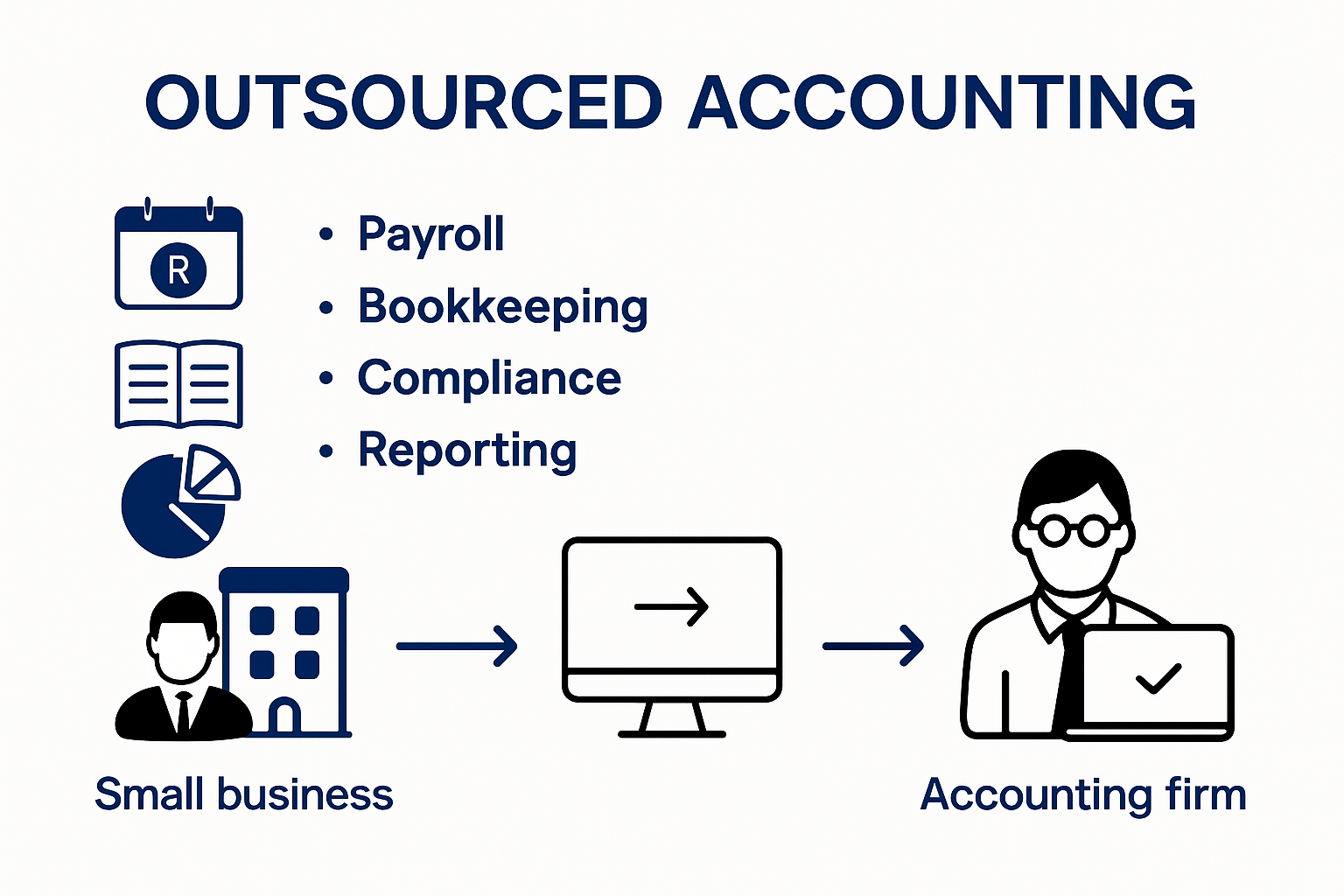
If the answer is frequently “no,” you may need more than bookkeeping software. You need a reliable bookkeeping process and someone who understands how to maintain it.
7. Your Accounts Don’t Reconcile Properly
Bank reconciliation is one of the foundations of accurate bookkeeping. If your bank, credit card, payment processor, or loan accounts aren’t regularly reconciled, errors can remain hidden.
Potential problems include:
- Duplicate transactions
- Missing transactions
- Incorrect categorizations
- Unrecorded fees
- Incorrect transfers
- Duplicate deposits
- Unusual balances
These errors can compound over time. Professional bookkeeping services typically include regular account reconciliation and review, helping identify discrepancies before they become larger problems.
8. You’re Growing Quickly
Growth is a good problem—but it creates financial complexity.
A company experiencing rapid growth may suddenly have:
- More revenue → more transactions
- More transactions → more expenses
- More expenses → more employees
- More employees → more accounts
- More accounts → more reporting requirements
The bookkeeping system that worked when you generated $10,000 a month may not work when you’re generating $50,000 or $100,000 a month.
The important point is this: Don’t wait until your bookkeeping breaks to build a better system. If you know you’re entering a growth phase, outsourcing bookkeeping early can help you build processes that scale with the business.
9. You Have Multiple Locations or Business Units
Multi-location businesses have another layer of complexity. You may need to understand:
- Revenue by location
- Expenses by location
- Profitability by location
- Payroll allocation
- Vendor expenses
- Intercompany transactions
- Location-level KPIs
This is particularly important for:
- Franchise owners
- Restaurant groups
- Property management companies
- Retail businesses
- Fitness businesses
- Multi-location service companies
If your financial reports only tell you how the entire company performed, but not which location is making or losing money, your bookkeeping may not be giving you enough information to manage the business effectively.
10. You Already Have an Accountant, But They’re Doing Your Bookkeeping Too
This is a situation many small businesses overlook.
Your CPA or tax accountant may be capable of handling bookkeeping. But ask whether bookkeeping is the best use of their time and your budget.
A more efficient structure can be:
- Bookkeeper → Maintains accurate monthly records
- Business Owner → Reviews performance and makes decisions
- CPA/Tax Professional → Handles tax, compliance, and higher-level advisory
This separation can make the entire financial workflow more efficient.
For CPA and accounting firms themselves, outsourcing bookkeeping can also help expand capacity without requiring immediate in-house hiring.
Global Ally Solutions provides outsourced accounting support designed to work alongside accounting firms and their existing teams.
Should You Outsource Bookkeeping or Hire an Employee?
Once you decide you need help, there’s another question: Should I hire an in-house bookkeeper or outsource bookkeeping?
There isn’t one answer for every business.
Hiring an In-House Bookkeeper
An employee can make sense when you have:
- Consistent full-time accounting work
- Complex daily accounting requirements
- A need for someone physically on-site
- Enough workload to justify a full-time position
- Internal processes that require dedicated staff
But the cost isn’t limited to salary. You may also have:
- Payroll taxes
- Benefits
- Paid time off
- Recruiting costs
- Training
- Equipment
- Software
- Management time
Outsourcing Bookkeeping
Outsourcing bookkeeping can be attractive when you need professional bookkeeping without creating another full-time position.
Depending on your provider and scope, you may be able to outsource:
- Monthly bookkeeping
- Bank reconciliation
- Credit card reconciliation
- Accounts Payable
- Accounts Receivable
- Financial reporting
- Catch-up bookkeeping
- QuickBooks support
- Management reporting
The major advantage is flexibility. You can start with the support your business actually needs and increase the scope as your company grows.
If you’re evaluating the cost difference between the two approaches, read our guide:
You Don’t Have to Outsource Everything
One of the biggest misconceptions about bookkeeping outsourcing is that you have to hand over your entire financial operation. You don’t.
You can outsource only the areas creating the biggest bottleneck.
Option 1: Monthly Bookkeeping
A provider handles transaction categorization, reconciliations, and monthly financial statements.
Option 2: Bookkeeping + Accounts Receivable
The provider also helps monitor outstanding customer balances and receivables.
Option 3: Bookkeeping + Reporting
You receive customized management reports and financial insights.
Option 4: Cleanup + Ongoing Bookkeeping
Your provider first brings your books up to date, then establishes a recurring monthly process.
This flexibility makes outsourced bookkeeping particularly useful for growing small businesses.
How to Choose an Outsourced Bookkeeping Service
Choosing the cheapest provider can create more problems than it solves. Before hiring a bookkeeping company, ask:
Do They Understand Your Industry?
A restaurant, franchise, property manager, and consultant can have very different bookkeeping requirements.
What Exactly Is Included?
Ask whether the monthly fee includes:
- Reconciliations
- Financial statements
- Accounts Payable
- Accounts Receivable
- Cleanup
- Reporting
- Communication and review
How Often Will Books Be Updated?
Monthly may be appropriate for many businesses, while higher-volume businesses may require more frequent support.
Who Reviews the Work?
A reliable process should include quality control rather than simply transaction entry.
What Software Do They Support?
If you’re using QuickBooks Online or QuickBooks Desktop, make sure your provider is experienced with your platform.
How Secure Is Your Financial Information?
Your bookkeeping provider will potentially have access to sensitive financial information. Ask about access controls, confidentiality, credential handling, and security procedures.
Can They Scale With You?
You don’t want to replace your bookkeeping provider every time your business grows.
A Simple Outsourcing Decision Checklist
Use this quick test. Give yourself 1 point for every “yes.”
Question
- Are my books frequently behind? Yes/No
- Do I spend several hours each month on bookkeeping? Yes/No
- Do I struggle to understand my financial reports? Yes/No
- Am I making business decisions without current financial data? Yes/No
- Has my transaction volume increased significantly? Yes/No
- Have I added employees or contractors? Yes/No
Question
- Do I have multiple bank or credit card accounts? Yes/No
- Do I operate multiple locations? Yes/No
- Does tax season require significant bookkeeping cleanup? Yes/No
- Would my time be more valuable spent on sales, operations, or growth? Yes/No
Your Results
0–2 Yes: DIY bookkeeping may still be reasonable if your books are accurate and current.
3–5 Yes: It’s worth comparing the cost and benefits of professional bookkeeping.
6+ Yes: Your business is likely ready for outsourced bookkeeping—or may already be overdue for professional support.
This isn’t a strict accounting rule. It’s simply a practical way to identify whether bookkeeping has become a meaningful operational burden.
What Happens When You Outsource Bookkeeping?
A professional transition doesn’t have to be complicated. A typical process looks like this:
Step 1: Assess Your Current Books
The provider reviews your existing bookkeeping setup, accounts, transaction volume, and outstanding issues.
Step 2: Identify Cleanup Needs
If previous bookkeeping is incomplete or inaccurate, the books may need catch-up or cleanup work before ongoing monthly bookkeeping begins.
Step 3: Define the Scope
You agree on exactly what will be handled each month.
Step 4: Establish Access & Workflows
Your bookkeeping provider receives appropriate access to your accounting software and supporting systems.
Step 5: Begin Monthly Bookkeeping
Transactions are categorized, accounts are reconciled, and financial reports are prepared.
Step 6: Review & Improve
As your business changes, your bookkeeping process can change with it.
The goal isn’t simply to “get the books done.” The goal is to create a reliable financial system that supports your business.
Why Outsource Bookkeeping to Global Ally Solutions?
At Global Ally Solutions, we help small and growing businesses maintain accurate books without the cost and management burden of building an entire in-house bookkeeping function.
Our support can include:
- Monthly bookkeeping
- QuickBooks Online, IES, R365, and Yardie expertise
- Bank and credit card reconciliation
- Accounts Payable
- Accounts Receivable
- Financial reporting
- Catch-up and cleanup bookkeeping
- Ongoing accounting support
We work with businesses across different industries and can tailor support based on the complexity and needs of your business.
Our goal isn’t simply to enter transactions. It’s to give business owners cleaner books, better financial visibility, and more time to focus on growth.
It’s to give business owners cleaner books, better financial visibility, and more time to focus on growth.
Learn more about Global Ally Solutions
You can also book a call with Gloria Prakash, Founder & CEO of Global Ally Solutions (30min) to learn more about the experience and approach behind the company.
Frequently Asked Questions About Outsourcing Bookkeeping
When should a small business outsource bookkeeping?
A small business should consider outsourcing when bookkeeping is taking significant time away from running the business, books are consistently behind, financial records are becoming more complex, or the owner needs more reliable financial reporting. There is no single revenue threshold that determines when outsourcing becomes necessary.
Is it worth outsourcing bookkeeping for a small business?
It can be. Outsourcing can provide professional bookkeeping support without the cost of hiring a full-time employee. The decision depends on your transaction volume, complexity, time constraints, and the value of your time.
Is outsourced bookkeeping cheaper than hiring a bookkeeper?
Yes. It can provide access to professional support while avoiding some of the overhead associated with employment.
Can I outsource bookkeeping if I already use QuickBooks?
Absolutely. QuickBooks is accounting software, not a substitute for bookkeeping expertise. Businesses still need someone to properly categorize transactions, reconcile accounts, review financial statements, and maintain accurate records.
Can I outsource only part of my bookkeeping?
Yes. You can outsource specific functions such as reconciliations, Accounts Payable, Accounts Receivable, monthly bookkeeping, cleanup work, or financial reporting. A partial outsourcing model can be a good way to transition away from DIY bookkeeping without giving up control of every financial function.
The Bottom Line: When Should You Outsource Bookkeeping?
There is no magic revenue number at which every business should outsource bookkeeping. Instead, look at what’s happening inside your business.
If:
- Your books are behind
- Your business is becoming more complex
- Bookkeeping is consuming your time
- You need better financial visibility
It’s probably time to outsource.
And don’t wait until tax season, a cash-flow crisis, or a major business decision forces you to act. The best time to outsource bookkeeping is usually before bookkeeping becomes a problem that affects the rest of the business.
If you’re spending your evenings reconciling transactions instead of growing your company, it may be time to hand the books to someone who does this every day.
Ready to find out whether outsourcing makes sense for your business?
Contact Global Ally Solutions to discuss your bookkeeping needs and find a support model that fits your business.